

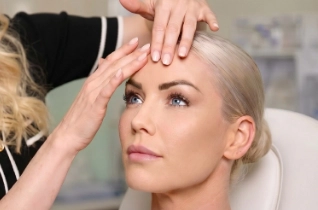
Why Do Forehead Lines Develop?
We all develop Forehead Lines over time. They are a natural result of our many facial expressions, particularly when we frown or lift our eyebrows. These movements, combined with structural changes in the skin over time, slowly allow these lines to develop.
As we age, our ability to produce collagen slowly declines. Additionally, elastin fibres lose their strength, reducing the skin’s ability to stay firm and supple. Other factors also contribute to the formation of lines. Lifestyle habits, sun exposure, environmental influences, dehydration, stress and genetics all play a role. Over time, these lines become more visible, even when the face is at rest.
Treatment Options
Just as many factors contribute to Forehead Lines, there are various approaches to treating the area. In fact, optimal results are achieved through a multifaceted approach. The most fundamental element of any treatment plan, though, is skin health, as healthy skin is more likely to respond optimally and maintain results over time.
Medical-Grade Skincare
To achieve healthy skin, patients must be prescribed a well-structured, medical-grade skincare routine. Medical-grade skincare is formulated with active ingredients that can penetrate the deeper layers of the skin, where collagen, elastin, and other essential components are located. By working at a cellular level, they can support skin resilience, skin repair and long-term changes in skin quality.
Conversely, commonly sold cosmetic skin care products (available at pharmacies and retail stores) provide benefits only to the surface of the skin, primarily by enhancing hydration and addressing the appearance of the outer layer. Unlike medical-grade skincare products, they do not affect the deeper structures of the skin.
Once a patient is consistently following a daily medical-grade skincare routine, we can consider other in-clinic treatments to help restore or support the area, depending on the depth and extent of the Forehead Lines.
Muscle Relaxant Treatments
While many contributing factors lead to the formation of Forehead Lines, the biggest contributor is repetitive muscle movement (by the frontalis muscle). Over time, these repeated contractions lead to the formation of visible Forehead Lines.
Muscle relaxants work by temporarily reducing the messaging between the brain and the specific forehead muscles. Once administered, we can inhibit these continual contractions, allowing the forehead to relax and help soften the appearance of Forehead Lines. The treatment also helps to prevent future Forehead Lines from forming.
You may see the first noticeable changes approximately three or four days after treatment, with the final results revealed at approximately two weeks post-treatment. New patients are often encouraged to return to the clinic for review at this stage to assess the results and determine whether any adjustments are required. Patients regularly receiving treatment don’t typically require review.
Muscle relaxant treatment is not permanent, though. Typically, patients see results from the treatment for two to three months, with the treatment’s longevity depending on factors such as metabolism, individual muscle strength, dosage and treatment history.
The patient’s facial anatomy should always be considered. For example, for those with heavier brows or upper eyelids, it’s often better to adopt a more conservative approach. Our forehead muscles help support the brows and upper eyelids, so they must retain some degree of movement to prevent the brows from falling and appearing heavier.
A good cosmetic nurse will know the importance of achieving the right balance between minimising Forehead Lines and maintaining natural brow support.
Volumising Treatments
Occasionally, if a patient has deeply established Forehead Lines that are not adequately softened by a muscle relaxant, we may consider volumising treatment. Importantly, though, a muscle relaxant must still be used, as ongoing muscle contractions will continue to cause lines. Still, volumising treatment will be an adjunct to soften the appearance of the forehead further.
Volumising products are synthetic substances designed to mimic the naturally occurring sugars found within our skin’s structure. There are various brands and formulations of volumising products, with varying consistencies and suitability for treating a multitude of skin issues.
Patients must understand that volumising treatments administered to the forehead carry a higher risk due to the presence of superficial arteries. If the product comes into contact with an artery, it can compromise blood flow to the surrounding tissues, potentially reducing oxygen supply. If not treated immediately, this can lead to tissue damage, delayed wound healing, scarring or tissue loss.
Rare but serious cases involve vascular complications that may affect the arteries that supply the eye. This can lead to visual impairment or blindness. Neurological complications are also potential risks. Given the seriousness of these, albeit rare, complications, volumising treatments in the forehead should only be considered after a comprehensive consultation with an experienced practitioner and after exploring all other options.
Dermal Treatment Options
Depending on the depth of your Forehead Lines, various dermal treatments may be recommended, such as the following.
Chemical Peels – These can be used to address skin quality and skin texture. Chemical peels range from superficial peels (with minimal downtime) that treat the outer layer of the skin to deeper peels (with more downtime) that target deeper layers. The type of peel prescribed for a patient depends on their skin condition and treatment goals.
Skin Needling (Microneedling) – Skin needling can help to soften the appearance of Forehead Lines. We use a dry-needling technique to control needle depth and angle precisely. Dry needling encourages collagen production, reduces the appearance of enlarged pores, refines skin texture and helps soften lines by promoting skin renewal and tissue contraction.
Light-based Therapy – These therapies stimulate new cell growth. This includes the production of collagen and elastin, which help address overall skin tone, quality, and texture. Light-based therapies typically require multiple sessions, with changes appearing over time. Although light-based therapies are excellent for skin rejuvenation, they may not be ideal for individuals with deeply ingrained Forehead Lines.
The Importance of an Initial Consultation
As every individual is unique, all patients must start their journey with an initial consultation with a cosmetic nurse practitioner. This way, their forehead area can be properly assessed, and all appropriate non-surgical treatment options and long-term skin health strategies can be discussed. This consultation is also an opportunity to ensure expectations are aligned and that you’re fully informed about your recovery and potential risks.
Your Comfort During The Procedure
To ensure your comfort during your procedure, we offer a range of pain management options. We may use topical numbing agents or a local anaesthetic. Additionally, we often ice the area to make the treatment more comfortable. Importantly, we ensure ample time is allowed so the treated area is adequately numbed. Rest assured, your practitioner will provide you with pain management options to suit your needs and the type of treatment you’re receiving.
Post-Treatment Responses
How you’ll feel after your treatment will largely depend on the type of treatment you’ve had. If you’ve had a muscle relaxant or volumising treatment, it is common to experience temporary redness, mild swelling, skin sensitivity or bruising in the treated area. These effects are generally short-lived and are a natural part of the healing process.
Post-Treatment Follow-Up
Your follow-up care will depend on the type of treatment you’ve had. Most treatments involve some post-treatment follow-up to ensure optimal healing, safety and the best possible outcome.
After certain treatments, you may be asked to send us images via email within a specific timeframe. At other times, particularly for new patients who have received a muscle relaxant treatment, they may be asked to return to the clinic for review.
Individuals receiving microneedling and/or LED therapy will need to return to the clinic regularly for ongoing treatments.
If patients are particularly bruised after any needle-based treatment, it may be recommended that they return to the clinic for LED therapy, as it supports healing and reduces inflammation.
Potential Risks & Side-Effects
All cosmetic treatments carry a level of risk, including treatments addressing Forehead Lines. Patients must understand that although many experience no adverse effects, side effects can occur and should not be underestimated.
During your consultation, your cosmetic nurse and prescribing practitioner will detail all potential side effects and risks associated with your prescribed Forehead Line treatments. These consultations are carried out before each treatment to ensure that your medical history, treatment suitability and individual risk factors are reviewed each time.
This continued consultation process encourages open communication, regular review of your treatment plan and confirmation that moving forward is still appropriate for you. Our focus is to ensure you feel well-informed, supported and confident about every decision you make regarding your care.
To learn more about potential risks, please see our Potential Risks and Complications page.
Costs
The cost of your treatment will depend on the type of treatment, the number of treatments required, the amount of product required and whether follow-up treatments or adjunct therapies are recommended.
All treatment plans are created for the individual; therefore, pricing can only be given after an in-person consultation with one of our cosmetic nurses.
