

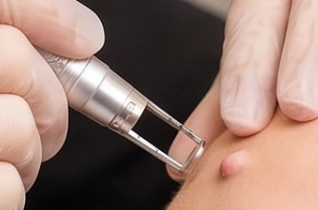
Sebaceous Cysts (epidermoid cysts) are benign, slow-growing lumps that develop beneath the skin. They often appear on the body, face, scalp or neck and are filled with keratin, a soft, cheese-like material produced by skin cells. While Sebaceous Cysts are mostly harmless, some individuals may opt for professional removal if they become infected, inflamed, painful or cosmetically annoying.
What Causes Sebaceous Cysts?
A Sebaceous Cyst can form when skin cells move deeper into the skin and become trapped. Instead of shedding normally, they multiply and produce keratin, which becomes trapped beneath the skin, forming a cyst.
These skin cells can become trapped for reasons that include:
- skin trauma or injury
- blocked hair follicles or oil glands
- genetic predisposition
- hormonal changes
- acne-prone skin
Treatment Options
Either Laser Treatment or Surgical Excision can remove Sebaceous Cysts. The most appropriate option will depend on the cyst’s size, location, and condition.
Laser Sebaceous Cyst Removal
Laser Cyst Removal is usually reserved for areas where minimising scarring is especially important, such as on the face or scalp. Laser treatment works by ablating (burning) a central channel into the head of the cyst, carefully passing through the skin and tissue to access the cyst contents.
Once the cyst is penetrated, the cyst contents are extracted. Then, forceps are used to remove the cyst sac. Sometimes, however, the cyst sac may separate or rupture. This means it cannot be completely removed during the procedure.
During the healing process, the remaining sac tissue often:
- dies off
- attaches to the forming scab. When the scab falls away, the remaining sac can come away with it
Occasionally, the scab may need to be professionally removed in-clinic, along with the remaining sac tissue.
Patients should understand the following issues associated with Laser Removal:
- There is always the chance that the cyst will return, particularly if part of the sac remains.
- Infected or inflamed cysts cannot be treated with a Laser, as they may require treatment first to settle the inflammation.
- As the Laser ablates the cyst tissue, no specimen can be sent for pathology testing, which might be necessary in some cases.
TREATMENT PROCESS
Your practitioner will first discuss the risks, procedure details, and anticipated healing process.
Before laser treatment commences, a topical numbing cream is applied to the area and allowed to take effect. For additional comfort, a local anaesthetic (administered via needle) may be administered to numb the area fully.
Once the area is numb, the Laser treatment will commence and take approximately 15 minutes to complete. Patients should allow about one hour for their appointment, though, as additional time is required for the consultation and preparation.
If the cyst is successfully removed, depending on the level of inflammation, patients may also receive a Light-Emitting Diode (LED) therapy session to help minimise inflammation and support healing.
HEALING
Following Laser treatment, it is normal to experience redness, swelling, bruising, mild bleeding or slight weeping at the treatment site. These symptoms may last for several days and are a normal part of healing. The treated area may also feel slightly sore and tender for a few days following the procedure.
A scab will develop over the treated area a day or two after the procedure, then fall away a week or two later. You mustn’t interfere with the scab in any way, as this can increase inflammation and the likelihood of scarring.
Once the scab has gone, the underlying skin may appear red, which is a normal part of the healing process. This redness usually subsides gradually over several weeks to months.
Surgical Sebaceous Cyst Removal
During surgical removal, the cyst and its surrounding sac are carefully excised through a small incision. In some instances, stitches may be required. If clinically indicated, the cyst may be sent to pathology for testing.
This method enables the cyst to be removed with the sac intact, which can help minimise the likelihood of recurrence.
Surgical removal is typically considered for:
- large or deeply seated cysts
- cysts that are inflamed or infected
- cysts located anywhere on the body other than the face or scalp
- situations where Laser Removal was unsuccessful
After-Care
After treatment, you will be given verbal and written after-care instructions.
You will also be given a topical healing cream to apply to the treated area three to four times daily until the skin has fully healed.
Keep the treated area dry until the scab has completely fallen away, and avoid exposing it to direct sunlight for at least four weeks after treatment.
Avoid using active or irritating skincare products on the treated area. This includes products containing tretinoin, retinol, glycolic acid, benzoyl peroxide, hydroquinone, salicylic acid, bleaching creams or chemical peels for at least two weeks after the procedure.
Avoid friction or rubbing on the treated area for several days after treatment.
If you notice any unusual signs of infection, inflammation or unexpected side effects, please get in touch with our clinic as soon as possible. If you require medical assistance after hours, please attend your local medical centre or emergency department.
Potential Risks
Complications following cyst removal are uncommon; however, they include the possibility of the cyst returning after treatment, especially if a portion of the cyst sac remains. Infection is also possible, though rare, when proper after-care instructions are followed. Changes in skin pigmentation (hypopigmentation or hyperpigmentation) may occur. In some instances, particularly in those prone to abnormal scarring, hypertrophic or keloid scarring may occur.
To learn more about potential risks, please see our Potential Risks and Complications page.
Treatment Costs
The cost of Sebaceous Cyst Removal depends on factors such as the cyst’s size, location, the required treatment method, and the complexity of the procedure. In some instances, we may recommend additional treatments, such as LED Light Therapy, medications, or follow-up care, to support healing.
To determine cost, all patients must have an in-clinic consultation. During this time, we can assess the cyst, recommend the most appropriate treatment and provide an accurate quote for the procedure.
