

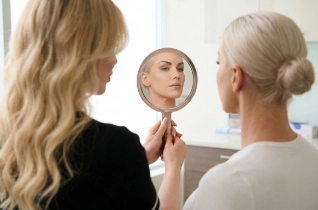
What Are Jowls?
Jowls are the sagging (ptotic), loose tissue that hangs below the jawline, causing a softer, less defined contour to the lower face. Often, the Jowl forms primarily due to volume loss and reduced support in the lower face.
What Causes Jowls?
Jowls typically develop slowly over time. Indiviuals begin to notice heaviness in the lower face, a softer jawline or skin that sits lower around the mouth and jawline.
Jowls appear for a variety of reasons:
- natural ageing and collagen loss
- loss of facial volume and support
- facial tissue dissent and fat pad movement
- weight fluctuations
- bone resorption (structural changes in the jaw over time)
- skin thinning and reduced elasticities
- genetics and natural facial structure
- fluid retention and reduced lymphatic drainage
Volumising Treatment for Jowls
The most common way to treat jowls is to administer a volumising treatment. Rather than addressing the Jowl itself, volumising product is placed in front of the jowl. This strengthens and defines the jawline, concealing heaviness in the area and making the jowls appear less noticeable.
Some patients also benefit from treating the surrounding areas to support the structure throughout the lower face. For example, the lower cheeks, chin or jawline can be addressed. These areas are always addressed conservatively, though, as excess product on the lower face can contribute to heaviness over time.
Types Of Volumising Treatments
It’s important that patients understand that not all Volumising Treatments are the same. Consequently, not all prices are the same. At Bella Plastic Surgery, we mostly use semipermanent products for Jowl Treatments. These products are firmer and more long-lasting, and are less likely to shift, providing more long-lasting structural support.
Other clinics may use a range of products that vary in thickness and longevity, and the cost usually reflects the product’s longevity.
- Entry-level products – are often thinner products designed to last approximately 4 to 6 months.
- Mid-range products – are typically thicker and designed to last approximately 6 to 12 months.
- Semipermanent products – are firmer products designed to last approximately 18 to 24 months.
Skin Boosters
Most individuals with jowls also have other changes in the lower face, such as skin thinning, texture changes, and fine superficial lines around the mouth. Treating these changes involves addressing skin quality to support the appearance of the lower face over time.
Sometimes, we may recommend skin boosters to address elasticity, hydration and overall skin function in the mouth and lower face. Instead of adding volume, these treatments aim to strengthen skin quality.
Skin boosters are frequently used in the lower face to address crepey skin texture, superficial lines around the mouth, skin thinning and early laxity through the jawline region.
Usually, a series of treatments is recommended, depending on your long-term goals and skin health.
Light-Based Therapy
As we age, our collagen levels naturally decline, which can contribute to skin thinning and laxity. Therefore, as part of an ongoing treatment plan, we may recommend light-based therapy to help maintain skin quality in the lower face.
Light-based therapy can help stimulate collagen activity, address skin texture and support overall skin health. Rather than treating jowls symptomatically, this treatment helps to slow the visible signs of ageing in the lower face and helps manage factors that contribute to their development.
Patients are assessed during an initial consultation to determine suitability and frequency of treatments.
Surgical Options For Jowls
If a patient has severe jowls and skin laxity, non-surgical options are often insufficient to achieve the desired outcome. In these instances, surgery may be a more appropriate option.
Surgical procedures for the lower face are designed to reposition facial tissue and adjust deeper supporting structures to address sagging (ptosis) and refine the jawline area. Rather than adding volume to specific areas, surgery focuses on structural change.
We recommend that individuals who want to explore surgical options contact a qualified Plastic and Reconstructive Surgeon or an Ear, Nose and Throat (ENT) surgeon who specialises in facial surgery and facelifts. During your initial consultation, the surgeon will discuss suitability, expected outcomes, recovery time, and risks and complications.
Volumising Treatment: What To Expect
Patients interested in Volumising Treatment will first have a consultation with a treating cosmetic nurse and prescribing doctor. They will fully review your medical history (including contraindications), assess your facial anatomy and propose a treatment plan for you. They will also discuss potential risks.
If you opt to proceed with treatment, the nurse will apply a topical anaesthetic for approximately one hour before treatment starts. (Ice is also sometimes used to increase comfort and help avoid bruising). When you are fully numbed, you will be taken into the treatment room. Your treatment plan will be reviewed once more, and all risks and after-care will be discussed again.
Treatment will commence after you have verbally consented. Volumising product will be carefully placed in specific areas of the lower face to strengthen the jawline, help disguise jowls and support more balanced facial proportions.
After your treatment, you’ll be given your product card, which documents your product details in batch numbers. You’ll also be given written after-care instructions.
To monitor you and ensure the area is settling as expected, we will ask you to email a clear photo of the treated area within 2 hours of your treatment.
Treatment Duration
Most Jowl Treatments take approximately 1½ to 2 hours, with additional time typically required for numbing.
Your Comfort
Most patients tolerate Volumising Treatment in the lower face well. The treatment typically includes a topical anaesthetic applied beforehand. Additionally, our volumising product contains a local anaesthetic, providing additional numbing throughout your procedure.
Treatment Longevity
Treatment longevity always depends on the type of treatment, the products used, the volume of product and the patient’s metabolism. At Bella Plastic Surgery, the volumising products we use for this treatment typically last around 18 to 24 months. However, some patients have reported results lasting more than 5 years. Some patients opt for small touch-up treatments over time, depending on their goals.
If you are having skin boosters or light-based therapy, these may only last a few months each time, and it’s likely we’ll recommend regular treatments.
Recovery Time
The time it takes to recover will depend on the type of treatment you’ve had and the areas being treated. Generally, downtime may include redness, skin tenderness, swelling and bruising. These effects can last from a few days to a week. Occasionally, effects may last longer, depending on the individual.
Your anticipated recovery time will be discussed during your consultation after your treatment plan has been proposed.
Potential Side-Effects
All cosmetic procedures carry risks and side effects. After Jowl Treatment, patients commonly experience minor side effects, such as swelling, bruising, redness, tenderness and subtle asymmetry. There may also be some discomfort in the lower face and jawline area for a week or more, as gravity can keep the swelling in place longer. However, more serious side effects can occur, such as skin necrosis, vascular compromise or vision changes.
To learn more about potential risks, please see our Potential Risks and Complications page.
After-Care
Your after-care will be discussed during your consultation. Before your treatment, you’ll also be given written after-care instructions to take home. Sometimes, we may recommend a light therapy session a few days after treatment to help with recovery and reduce discomfort.
Results
Your results will be more visible approximately two weeks after treatment, once most of the swelling has settled. Some patients experience mild swelling persisting for longer periods.
