

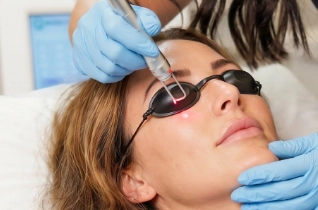
Milia are the small, firm white cysts or bumps that appear on the skin. They are usually around one to three mm wide and form when keratin (skin proteins) becomes trapped under the skin’s surface. They don’t respond to squeezing or exfoliation as they are covered with a thin layer of skin, making them difficult to remove without professional treatment. Milia typically appear around the nose, cheeks or eyes.
How Laser Treatment Works
Milia can be removed using dual laser technology. The laser creates a very small opening in the skin, allowing the trapped keratin to be carefully extracted. The laser cauterises the entry point, minimising bleeding. This allows the area to be treated as a dry wound, without the need for a dressing.
Laser Milia Extraction: What To Expect
Before treatment, a topical anaesthetic is applied to the area for 30 to 60 minutes. This is usually all that is required to maintain comfort during the procedure. Due to the speed and precision of treatment, it is usually well-tolerated and best described as mildly uncomfortable.
Treatment time varies depending on the number of Milia being removed. Typically, the laser removal only takes a few minutes; however, an appointment usually takes 30 minutes to allow for the consultation, documentation and receiving after-care instructions.
Recovery
After your appointment, a tiny scab will form at each treatment site and usually remains for one to two weeks. During this time, you may experience tenderness, redness, mild swelling and slight exudate (yellow/clear fluid).
Once the scab falls off, the underlying skin will be pink and will slowly heal over the following weeks.
You’ll be given a topical medical-grade cream to apply three to four times a day until the scabs have fully resolved.
Follow-up Care
We recommend a follow-up appointment 3 to 4 days after your treatment. During this appointment, we might use light-based therapy to support your healing process. We will also determine whether subsequent appointments are required, based on how your skin is healing.
Cost Of Laser Milia Removal
To determine the cost of Laser Milia Removal, you’ll need an in-person consultation at our clinic. The cost will depend on how many Milia need to be removed and the time required to remove them.
Alternative Treatments
It is possible to treat Milia using a sterile needle to open the cyst and then manually extract the contents. Although effective, it is less controlled and precise than an ablative laser, particularly for deeper lesions.
Manual extraction is a popular ‘at-home’ treatment but is not recommended as it can lead to irritation, incomplete removal, scarring and inflammation.
Potential Risks & Side-Effects
Side effects and risks for this procedure are relatively uncommon. However, they can include delayed healing, infection, pigmentation changes (lightening or darkening of the skin), crusting or blistering, and scarring (including hypertrophic or keloid scarring).
To learn more about potential risks, please see our Potential Risks and Complications page.
