

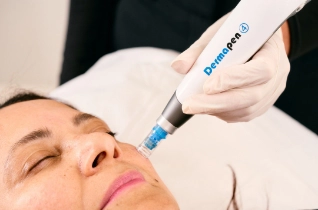
Micro-Needling (Skin Needling) is a minimally invasive, clinically guided skin treatment. It uses evidence-based techniques to address skin texture, support collagen stimulation and address issues such as uneven skin tone, enlarged pores and scarring. Each client is given a personalised treatment plan.
How Micro-Needling Works
During a microneedling session, ultrafine needles create a series of controlled microchannels in the skin. This creates micro-injuries that activate the skin’s natural repair processes, which encourage increased cellular activity and collagen production.
Micro-needling is commonly used to support changes in skin texture and tone, pore appearance and scarring (including acne scarring).
Post-surgical scars and acne scars sometimes require deeper needle penetration (up to approx. 3 mm). They must be performed by appropriately qualified doctors or registered nurses in accordance with Australian health practitioner regulations.
What Micro-Needling Treats
Micro-Needling can help support various skin concerns, such as:
- Uneven skin texture or tone
- Fine lines and wrinkles
- Visible or in large pores
- Acne scarring and other textural scars
- General skin dullness and ageing
Skin Needling can produce noticeable changes not long after treatment; however, the extent and longevity of results vary. For patients wanting longer-term skin remodelling, Skin Needling is typically most effective when incorporated into a broader, personalised treatment plan that includes supportive therapies and appropriate at-home skin care.
Medical-Grade Micro-Needling Vs At-Home Micro-Needling Devices
There are several at-home Micro-Needling devices marketed in Australia for skin rejuvenation. Although they appear similar to professional models, there are significant differences between at-home Skin Needling devices and medical-grade Micro-Needling devices used in a clinical setting by registered doctors and nurses.
Needle depth: A critical difference is the needle’s depth. While at-home devices typically penetrate 0.5 to 1 mm, medical-grade microneedling devices can penetrate up to 3 mm, allowing for a significantly deeper, more effective treatment.
It must be understood that to achieve a significant benefit to the skin, the needle must reach the dermis. The dermis is the second layer of the skin and sits between 0.5 and 1.5 mm below the skin’s surface. It is responsible for the production of collagen and elastin. To stimulate a reasonable wound-healing response and support structural skin changes (scarring, fine lines and wrinkles, and the appearance of pores), treatments must reach this dermal layer.
In contrast, at-home devices cannot consistently and safely reach this depth. Therefore, they are unlikely to produce the level of collagen stimulation needed for long-term or significant skin change.
Adjunct therapies: Another critical difference between at-home and in-clinic Micro-Needling devices is the ability to use adjunct therapies not available for home use. For example, Low-Level Laser Therapy and Light Emitting Diode (LED) therapy are often used after microneedling to help reduce inflammation, support cell viability and encourage new cell growth. Such modalities play an essential role in maximising treatment outcomes while also supporting a healthier, more controlled healing response.
Medical-grade topical treatments: Targeted, medical-grade topical treatments are applied during and after professional microneedling. They support collagen production, cellular health and skin recovery. They are specifically formulated for use on compromised or treated skin and selected based on treatment depth and individual skin needs.
Micro-Needling For The Neck And Decolletage
After a clinical assessment, microneedling can be used to support skin quality and texture in the neck and decolletage areas.
The skin is thinner in these areas and may display early signs of textural change and ageing. We approach Skin Needling treatment in these areas conservatively, carefully adjusting the depth and technique based on individual characteristics, skin thickness and sensitivity.
Micro-Needling For Post-Surgical Scars
Microneedling can also help treat scars. However, the surgical site must be fully healed and clinically appropriate to treat. The needle penetration depths are adjusted to work through the base and margins of scar tissue to support scar appearance and texture. The approach, needle depth and session frequency vary based on the type of scar, its location and the individual’s healing response.
Micro-Needling For Hand Rejuvenation
Hands can display skin thinning and early changes in texture. Micro-Needling can be performed on the hands using appropriate, modified settings to support skin texture and quality.
Micro-Needling Treatment Response & Review
While we are confident that Skin Needling typically reveals visible skin changes after every treatment session, if no visible change is seen after the first session, we don’t recommend proceeding with further sessions. This is because the effectiveness of Skin Needling should be evident at every stage. Continued skin remodelling should be supported through ongoing treatments when delivered as part of a personalised, structured plan.
Supporting Micro-Needling Outcomes
Micro-Needling is often included in a comprehensive skin treatment plan. It can be combined with supportive modalities, such as medical-grade skincare and light-based therapies, to help maintain cellular activity after treatment.
LED therapy, or low-level laser treatments, is sometimes recommended in the days following microneedling, then again at one- and two-week intervals. This helps support recovery and cellular regeneration.
Dry Micro-Needling
Dry Micro-Needling involves treating the area without any topical lubricant. This allows for a more direct mechanical interaction between the needles and skin. Acne scarring or in large pores are often targeted in this way, where precise tissue stimulation and contraction are required.
Dry Micro-Needling can be used to:
- Decrease the appearance of fine lines and wrinkles
- Stimulate collagen and elastin (through mechanical stimulation)
- Encourage localised skin contraction
- Support the reduction in the appearance of enlarged pores
- Help reduce tethered scar tissue
- Address acne scarring by working through scar margins and bases
Dry Micro-Needling is also a non-thermal treatment option suitable for a wide variety of skin types, including pigment-prone or sensitive skin (subject to assessment). Compared to other heat-based resurfacing treatments, it also has reduced downtime. And, as this technique does not rely on thermal energy, it can be suitable for those with sensitive skin, pigmentation concerns or melasma (chloasma).
Pre-Treatment Considerations
Several brief treatment factors must be considered before commencing Micro-Needling to help ensure appropriate treatment planning, patient safety, and optimal skin response.
- Pre-treatment skincare preparations might be discussed and recommended during your initial consultation.
- Certain medications, such as isotretinoin (Roaccutane), are contraindicated. Typically, Skin Needling is not performed while patients are on these medications.
- Individuals who are under the care of a medical specialist or taking prescription medications that could affect healing or skin response may require medical clearance.
- Some topical skincare products may need to be discontinued at least two weeks before treatment, depending on their formulation, treatment intent and frequency of use. Examples include Vitamin A derivatives and hydroquinone.
- Open wounds, sunburn, breaks in the skin or active skin infections could require Skin Needling to be postponed until the skin has fully settled.
- Your Initial Consultation & Skin Assessment
- Before starting with Micro-Needling, all patients must have an initial consultation. During this time, we will review your lifestyle factors, medical history, current skincare products and treatments and treatment goals to determine whether Micro-Needling is appropriate for you.
- We will also create a personalised treatment plan, recommend supportive therapies and skincare, as well as provide education on skin anatomy, explain how Micro-Needling works and how you can support your skin health after treatment.
- Your Treatment Day
On the day of your treatment, we’ll first prepare the skin and apply a topical anaesthetic to help reduce any discomfort. This anaesthetic remains on the skin for approximately 60 minutes.
Before commencing treatment, your cosmetic nurse will review the procedure and explain each step. During Skin Needling, the device may make a mild sound. Your nurse will monitor your comfort throughout the treatment.
After treatment, we will apply medical-grade skincare products specifically formulated for compromised skin. These formulations are amino acid-based and support collagen synthesis and skin healing. Sometimes, low concentrations of actives, such as vitamin C or vitamin A, are included to help with recovery while minimising irritation.
- Post-Treatment Care And Recovery
- Following your micro-needing treatment, you must adhere to the appropriate aftercare. This supports skin healing, optimises treatment outcomes, helps minimise the risk of complications and reduces irritation.
- Avoid liquid makeup for the first 24 hours; you may use mineral makeup once redness has settled.
- Temporary sensitivity and redness are to be expected; for comfort, you may apply a cool compress.
- Gently cleanse the skin using lukewarm water and a recommended post-treatment cleanser.
- Thoroughly wash your hands before touching your treated skin, as multiple micro-channels to the dermis will be temporarily present.
- Do not disturb or pick the skin, even if you experience a breakout during the renewal process.
- Apply a broad-spectrum SPF 50 plus sunscreen once redness has settled, and stay out of the sun.
- Avoid intense exercise, steam rooms, hot tubs, saunas and alcohol for the first 24 hours.
- Depending on professional guidance and your skin’s response, you may start gentle exfoliation.
- Keep your treated skin well moisturised using your recommended medical-grade skincare. During the initial healing phase, apply the products multiple times a day.
Frequency Of Treatments
Most patients should notice visible skin changes after their first treatment. If no change is seen, we do not recommend further sessions.
Provided that changes are seen, we often prescribe a series of three to four treatments at least four weeks apart. Depending on your skin goals, microneedling may be recommended periodically as a maintenance treatment.
Reducing Discomfort
Generally, Micro-Needling is well-tolerated by most people. To reduce any discomfort, we apply a topical anaesthetic, which is usually adequate for most. However, during your treatment, you will notice some discomfort, as fine needles are used.
Potential Risks & Complications
Swelling, temporary redness or mild bruising are typical and expected. Less common side effects include flaking, dryness, prolonged irritation or pigment changes. Rare complications include inflammatory nodules, infection or granulomatous reactions.
If symptoms worsen, or if signs of infection or systemic response occur, please contact the clinic.
To learn more about potential risks, please see our Potential Risks and Complications page.
Cost of Micro-Needling
As Micro-Needling is a procedure tailored to the individual, pricing is not fixed until you’ve had your initial consultation and assessment. Individual tailoring ensures that your treatment is safe, appropriate and aligned with your skin requirements. Your tailored plan will be given to you at the end of your consultation and includes an outline of recommended sessions and associated costs so you can make a fully informed decision before proceeding.
Factors that influence the cost of your treatments include your skin concern, treatment area, depth required and whether you’ll have additional supportive therapies incorporated into your plan.
Sometimes, Micro-Needling may be performed as a standalone treatment without any adjunct therapies. At other times, we may recommend a broader skin treatment plan that includes supportive therapies, such as medical-grade therapy and LED treatment.
