

Your sebaceous glands are tiny organs in your skin that secrete sebum. Sebaceous Hyperplasia refers to enlarged sebaceous glands. This condition is typically found on the face and presents as small, skin-coloured or yellow bumps up to three millimetres in diameter.
Sebaceous Hyperplasia Removal Procedure
Although the removal process only takes a couple of minutes, your procedure will take approximately 30 minutes. This is so we can complete all paperwork, discuss your issues and concerns and explain all post-care requirements.
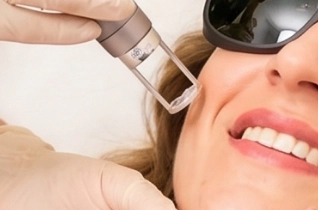
During your procedure, we will use the dual laser, the only laser device designed with a small pen tip head, shaped to specifically target sebaceous hyperplasia without causing any damage to surrounding skin tissue.
Typically, you will only require one treatment for removal; however, subsequent touchup treatments may be necessary in rare cases.
Is Laser Sebaceous Hyperplasia Removal Painful?
Removing sebaceous hyperplasia is often described as ‘uncomfortable’, but not painful enough to warrant anaesthetic. This is mainly due to the speed and precision of the laser. Sebaceous hyperplasia removal is tolerated well amongst most age groups. However, if you’d prefer an anaesthetic, we can give you various anaesthetic options to ensure that you have the right level of pain relief to suit your preferences.
Post Procedure Results
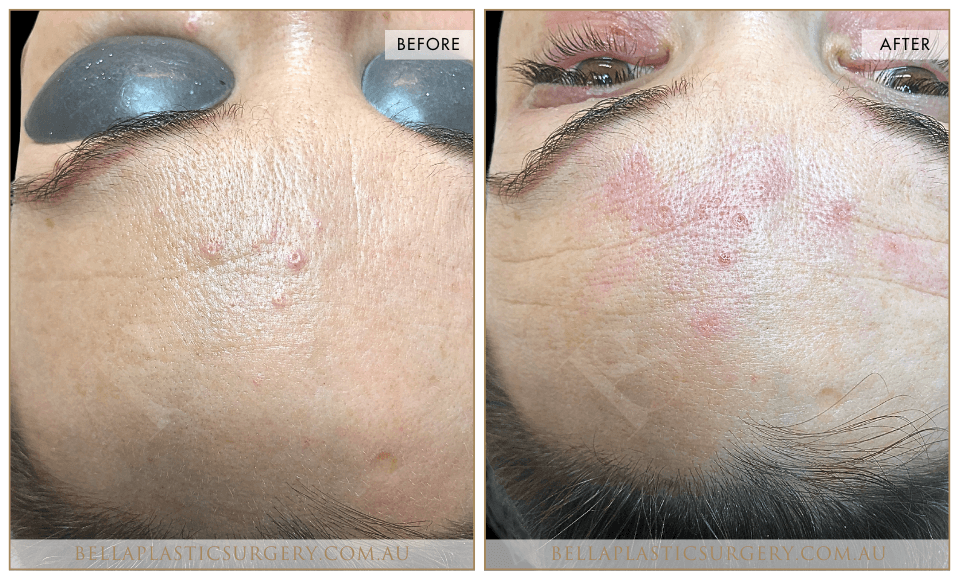
Immediately after your treatment, you can expect redness and possible swelling in the treated areas. This redness typically lasts around a week or so post-treatment.
While you’re healing, a temporary scar will form, which is a natural part of the healing process. Scabbing typically falls off within seven to 14 days. Once your scabs have fallen off, the areas will be red. This redness will slowly subside over several months.
Post-Procedure Care
After your treatment, you’ll receive a detailed post-care form from us, along with verbal instructions for caring for your treated area.
Three to four days after your treatment, please send us an image of the treated area. We’ll ask you to do the same at two and six weeks post-treatment. This ensures that your treated area is healing well and that you’ve kept the scab intact. During your healing, you can call the clinic with any questions or concerns. You can also book a face-to-face consultation to discuss your issues further.
You can wear make-up during your healing process; however, we’ll offer recommendations regarding the best type of make-up to use.
In some cases, we provide patients with a topical cream for use after skin injury. This cream provides nutrients to accelerate the skin healing process. We also offer LED treatments to accelerate your healing process.
Your Procedure
Although the removal process only takes a couple of minutes, your procedure will take approximately 30 minutes. This is so we can complete all paperwork, discuss your issues and explain all post-care requirements.
During your procedure, we will use the dual laser, the only laser device with a small pen tip head, designed to specifically target Sebaceous Hyperplasia without damaging surrounding skin tissue.
Typically, you will only require one treatment for removal; however, subsequent touch-up treatments may be necessary in some cases. As this condition is chronic, further treatments may be required as new lesions develop.
Number of Treatments Required
Typically, most individuals only require one session to treat a lesion, although the number of treatments required depends on the depth and size of the lesion. Occasionally, a follow-up treatment may be required. As Sebaceous Hyperplasia is a chronic condition, patients should be prepared to have further treatments in the future as new lesions appear.
Skin Cancer Check
Whenever a laser device is used to remove a lesion from the face or body, we strongly recommend that patients have a skin cancer assessment before treatment. This is irrespective of the type of lesion being treated.
Potential Risks
All skin procedures carry risks. Risks for Laser Sebaceous Hyperplasia Removal include delayed healing, scarring, pigmentation changes and infection. Healing outcomes vary from person to person.
To learn more about potential risks, please see our Potential Risks and Complications page.
Cost
All treatments are assessed on an individual basis, depending on the complexity of the procedure and the number of lesions being treated. To determine costs, an in-person consultation is required.
