

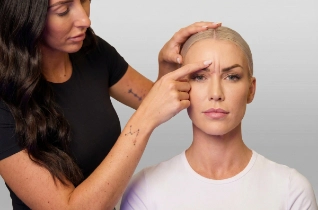
Frown Lines are the vertical lines that form between the eyebrows. They can look different for everyone. Some are only visible when you frown or make expressions. Others are deeper and can be seen when your face is relaxed. There are several non-surgical treatment options available for Frown Lines, and the most suitable choice depends on your individual requirements.
What Causes Frown Lines?
Frown Lines often form from repeated facial movements when we frown or make certain facial expressions. When the muscles between the eyebrows are very active, lines can appear when you frown. They can gradually become more noticeable over time. In some cases, these lines may still be visible even when your face is relaxed. Skin quality, genetics and lifestyle factors can also play a role by affecting the skin’s collagen and elastin.
How to Treat Frown Lines
There are several treatment options for Frown Lines, depending on your anatomy and tissue concerns. A common treatment involves administering a muscle relaxant. This is created to reduce muscle contraction and help minimise the visibility of Frown Lines. Sometimes, if lines are present even when the muscles are relaxed (after administering a muscle relaxant), we may also use volumising products. Volumising product is placed directly into the lines to help reduce their appearance.
Sometimes, we plan to use different products at different times. For example, we often suggest a muscle relaxant treatment first. Once the muscle relaxant starts to work, we can see the skin relax and administer volumisers to address any static lines.
Occasionally, we may discuss other treatments to address Frown Lines, such as ablative laser treatments and other skin-focused treatments, depending on individual concerns and suitability.
Muscle Relaxants
This treatment involves administering a muscle relaxant to the muscles responsible for frowning. This temporarily interrupts signals from nerves to the muscle, reducing muscle contraction and limiting movement in the area.
The initial results of this procedure are noticeable after a few days, and it can take up to two weeks to reach full effect. By this stage, the targeted muscles have been significantly relaxed, so frowning is reduced substantially.
Volumising Treatment
Volumising treatment is usually commenced after your muscle relaxant treatment. A synthetic product similar to a naturally occurring substance in the skin is applied directly to the area to help reduce the appearance of deeper frown lines.
NB: Volumising treatments are considered a high-risk option in the Frown Line area. This is because vital blood vessels sit close to the surface of the skin, and there is always a small risk when using a needle that the product could enter a blood vessel. This can lead to serious complications, including reduced blood flow to the forehead or eyes. This may lead to visual impairment or blindness in rare cases. Therefore, the risks must be clearly discussed with you during your initial consultation.
Volumising treatment in this area is often only considered as a last option and should be performed in a clinical setting with appropriate medical support available.
Ablative Laser Treatments
Ablative lasers have been used for many years to improve skin issues such as sun damage, fine lines and wrinkles. The most common types are Erbium and CO2 lasers.
Erbium lasers target water within the skin. This causes controlled removal of skin layers, and can vary from partial ablation (where a portion of the skin is treated) to full ablation (where the entire surface layer is removed).
CO2 lasers deliver focused heat into the skin. This creates controlled channels that allow new skin and tissues to form while healing.
When addressing deep fine lines, laser options are not highly recommended, despite their ability to create noticeable changes in skin quality. Frown lines are typically caused by muscle activity, so addressing the muscle movement is almost always the primary treatment option.
Additionally, ablative lasers entail significant downtime and potential risks. (Please see information below.) For this reason, we encourage patients to consider less invasive non-surgical options first.
Comfort During Treatment
To keep you comfortable during your treatment, we have a range of numbing options available. We can use a topical anaesthetic, applied for 30 to 60 minutes before treatment, depending on the procedure performed. Alternatively, we can use a local anaesthetic given via injection, where appropriate. Additionally, volumising products also contain lignocaine, which numbs the injected area.
Frown Line Treatment Costs
Treatment costs vary, depending on the type of treatment and the number of sessions required. This will be determined during your initial consultation, where a detailed treatment plan will be created. This will outline all costs, including any ongoing or future treatments required.
Potential Risks & Complications
All non-surgical treatments for Frown Lines carry some risk. While most individuals don’t experience any issues, they can occur. Therefore, all side effects should be discussed and acknowledged before proceeding with any procedures.
Muscle relaxants: Side effects can include a feeling of heaviness in the brow area, drooping of the upper eyelid (ptosis), bruising, swelling, temporary headaches or asymmetry. Other rare side effects may also occur and will be clearly discussed during your initial consultation.
Volumising treatments: When administered in the brow area, Volumising treatments carry a higher level of risk than other facial areas. This is due to the fact that essential blood vessels are located close to the skin’s surface. In rare cases, complications can affect blood flow to the forehead or eyes and can result in serious outcomes such as blindness or visual impairment.
Ablative lasers and other treatments: These involve additional risks and downtime, including changes in skin pigmentation, different forms of scarring, and infection. Some treatments may require further medical or surgical intervention if complications arise.
To learn more about potential risks, please see our Potential Risks and Complications page.
